
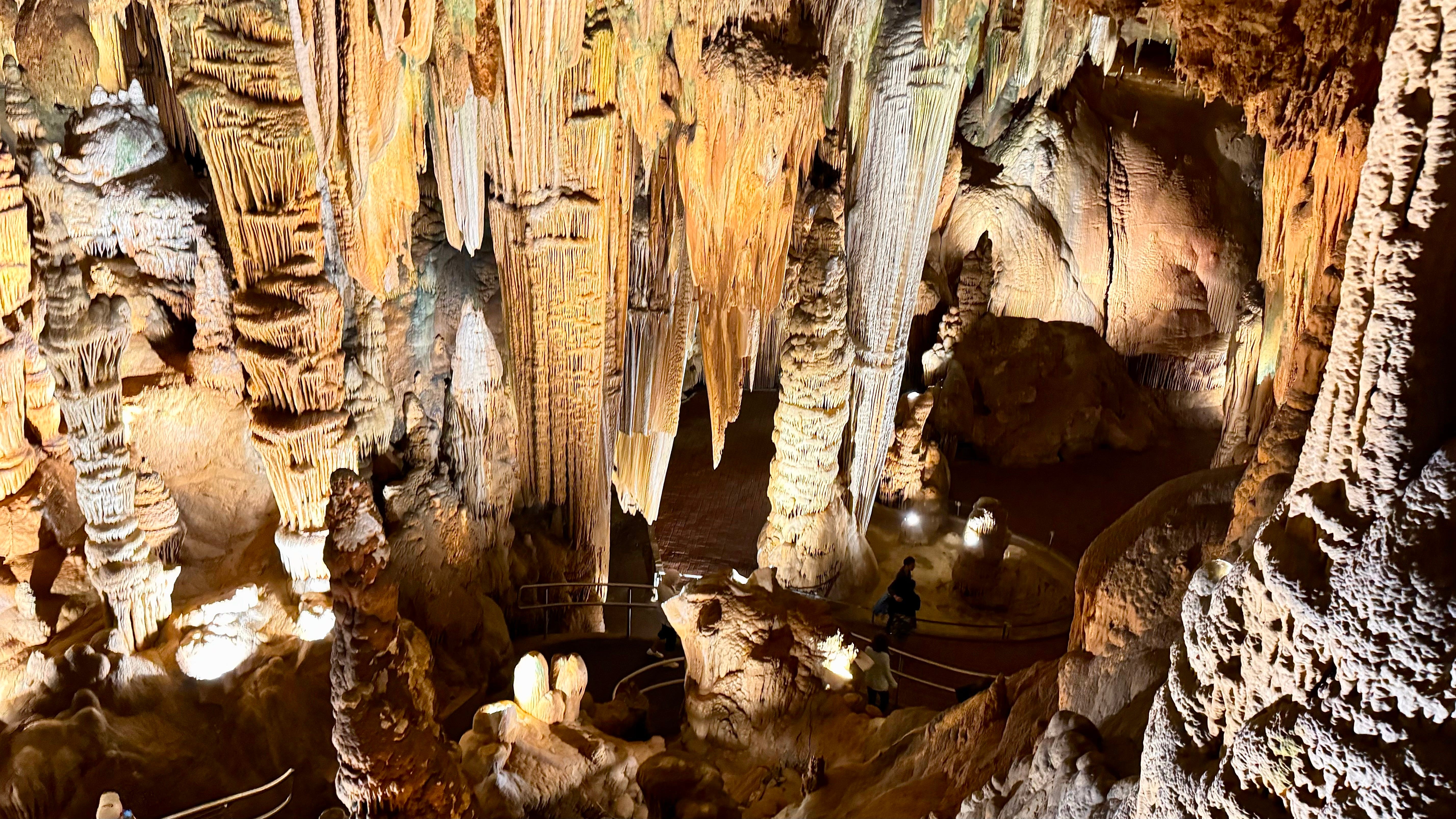
Above ground, the lowlands look settled: pasture, corn stubble, a church steeple. Below it, the rock is full of holes.
Much of the region’s bedrock is limestone and dolostone, and both dissolve in slightly acidic water. A Washingtonian guide to the caves compares the lowlands to Swiss cheese and reports that Virginia holds more than 4,000 caves, most of them wild and untouched by development.
Slow Acid, Long Patience
Britannica’s entry on Luray Caverns gives the short version. Underground rivers and acid-bearing water seeping through layers of limestone and clay formed the chambers over millions of years. The clay washed out and left the limestone shell. Later, dripping limewater built the stalactites.
The slowness is the point. The Washingtonian reports that a formation can take about 120 years to grow a cubic inch, which explains the strict rule against touching: oils from skin can stop a formation’s growth.
The same chemistry works at the surface. Natural Chimneys Park in Mount Solon holds a 120-foot limestone formation that rain has sculpted for a very long time. The towers stand in daylight. The caves hold the rest of the story in the dark.
Six Caves With Lights and Handrails
According to the Washingtonian, six of the Shenandoah Valley’s caves are show caves with lights, paved paths and admission fees: Luray Caverns, Shenandoah Caverns, Endless Caverns, Grand Caverns, Skyline Caverns and the Caverns at Natural Bridge. Inside, the temperature holds around 55 degrees and cell phones lose their signal.
Each has a character of its own.
Luray is the giant. Its caverns were discovered in 1878 and cover 64 acres, Britannica says. In 1956 builders placed rubber-tipped plungers beside 37 stalactites to make a stalacpipe organ, which Britannica calls the largest natural musical instrument.
Grand Caverns in Grottoes holds an older distinction. The Washingtonian calls it the nation’s oldest cave concession, with part of it opened in 1806, and says its walls carry more than 200 signatures left by Civil War soldiers. Visit Shenandoah notes that its beds of rock run vertical, unlike the mostly horizontal layers elsewhere, and that it is known for its shield formations, whose exact origin remains uncertain.
Endless Caverns, discovered in 1879, sits at the foot of Massanutten Mountain. The same Visit Shenandoah guide says the name is not literal, though long sections of the cave have never been explored.
The Fall Swarm and a Hard Decade for Bats
Virginia has only 17 documented species of bats, according to the state Department of Wildlife Resources. In the fall, the agency says, cave bats gather around cave entrances during a period called the swarm, feeding heavily before hibernation.
October sits inside that window, and the news from the caves has not been easy. The Virginia Department of Conservation and Recreation reports that white-nose syndrome, a fungal disease that rouses hibernating bats and burns their fat reserves, reached Virginia in 2009. Between 2009 and 2013 it spread across western Virginia. Little brown, tricolored and northern long-eared bats suffered estimated mortality above 95 percent.
There is a small turn in the record. The same agency says little brown and tricolored bats persist and appear to be slowly increasing in number.
Hands in Pockets, Boots Clean
Visitors can help. The department advises avoiding disturbance of hibernating bats and asks anyone who enters a Virginia cave to assume they may carry spores of the fungus on their gear and clothes. On a commercial tour, that means following the guide’s rules about where to step and what to touch. In wild caves it means leaving them alone through the hibernation season.
Hours, ticket prices and seasonal tour offerings change, so confirm them with each cave before you drive out. Dress for 55 degrees, wear shoes with grip, and keep your hands to yourself.