

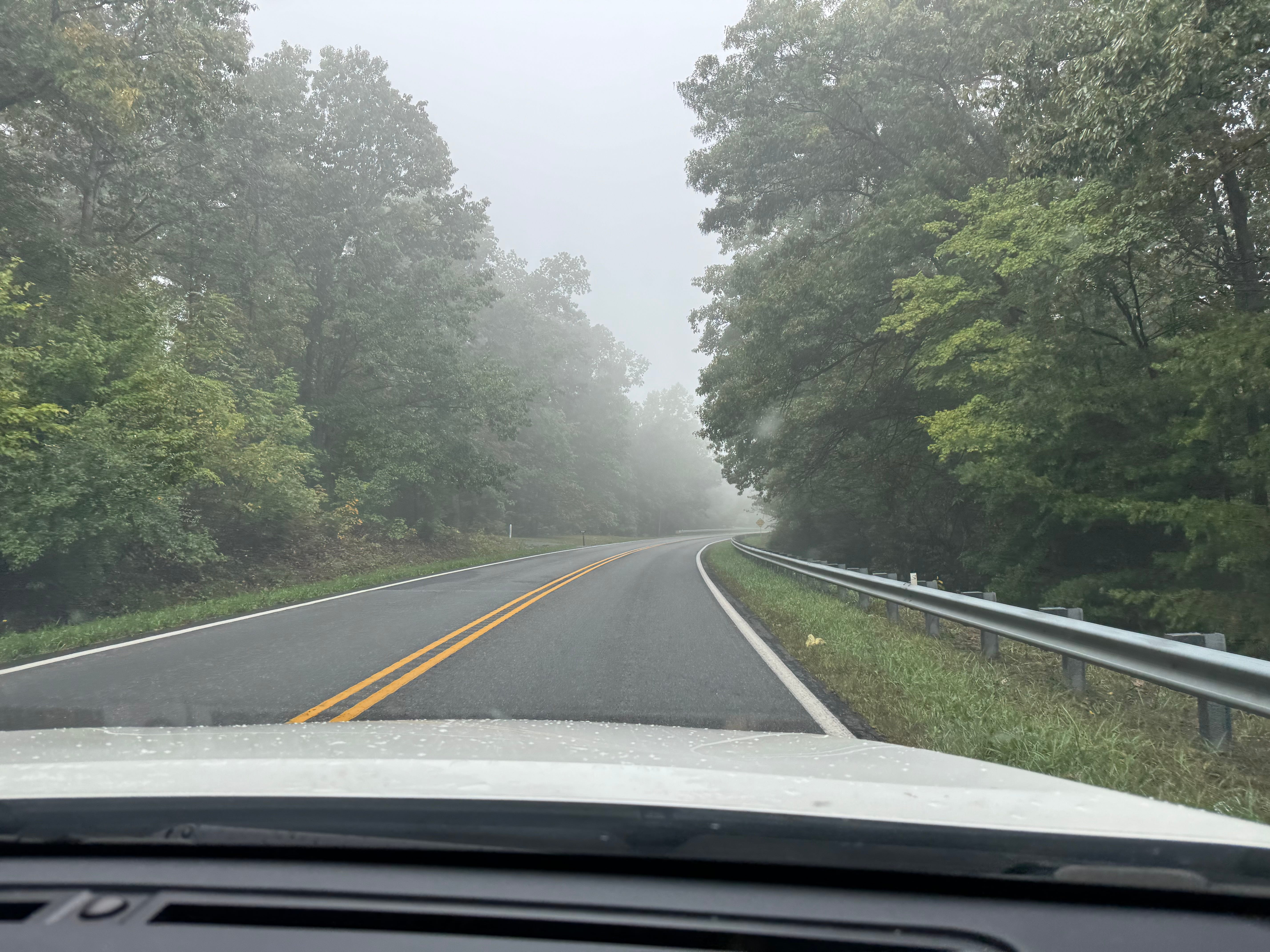
Drive Interstate 81 before sunrise in October and the lowlands can vanish under a pale blanket as the ridgelines poke through, lit and clear. Meteorologists call it valley fog. WHSV’s weather team has described it as something that happens very often in the Shenandoah Valley, and the cause is ordinary physics working on an extraordinary landscape.
Cold Air Runs Downhill and Takes the Moisture With It
Start with the sky. On a clear night with no cloud cover, the ground gives up its heat quickly. The Cloud Appreciation Society explains that the long nights of autumn and winter make this loss greater, and that a starry night with barely a breath of wind is the ideal setup. The air touching the ground chills until some of its moisture condenses into droplets. The result is a cloud that sits at ground level.
Cold air is heavy. It does not hover where it forms. It drains downhill the way rainwater does, collecting in the lowest ground it can find. That drainage is why the fog pools in valleys and the slopes above stay dry and clear.
The Rivers Bring the Water
A valley with water in it makes better fog than a dry one. A University of Wisconsin satellite meteorology course notes that radiation fogs are frequent in fall in river valleys, where cold air settles to the bottom and the rivers and streams add water vapor by evaporation. From orbit, the same course says, valley fogs trace the contours of the river valleys beneath them.
Between the Blue Ridge and the Alleghenies, the lowlands are threaded with exactly that kind of water. The mountains add something else. According to WHSV, the air gets trapped between the ridges, and a fog can linger for several days.
Dew Point, Wind Speed and a Bet on Tomorrow
The Wisconsin course offers a guideline for predicting a fog night. If the dew point sits roughly 5 degrees Celsius (about 9 degrees Fahrenheit) below the air temperature at sunset, and winds are forecast to stay under 5 knots (about 6 miles per hour), a radiation fog has a good chance of forming overnight.
Any weather app that shows dew point and wind will give you both numbers. Check them in the evening. A narrow gap between air temperature and dew point, a calm forecast and a clear sky make a good bet for the next morning.
Why Some Fogs Linger for Days
NASA’s Earth Observatory, writing about fog in Australia’s Victorian Alps, describes the usual pattern. At low elevations radiation fog fades as the sun warms the ground, but in mountain valleys it tends to stay longer because the valley floors remain shaded. The physics is the same in Virginia, though the scale differs.
That timing is the reason to be out early. The best view arrives in the first hours of light, and the fog gives way as the ground warms.
Climb Out of the River Bottom Before Sunrise
Fog follows rivers and pools low, so the view belongs to higher ground. Any road or trail that climbs out of a river bottom gives you the angle. Scout the spot in daylight, since you will be driving to it in the dark. Bring a layer more than you think you need, because the same clear sky that makes the fog also makes the cold.
The fog makes no promises. It needs a still night, a clear sky and moist air to line up. When they do, the morning rewards the person who got up.
I totally feel like I am there! Thanks. SNP is my favorite place on earth and I think it beats Disney World by far as the happiest.