

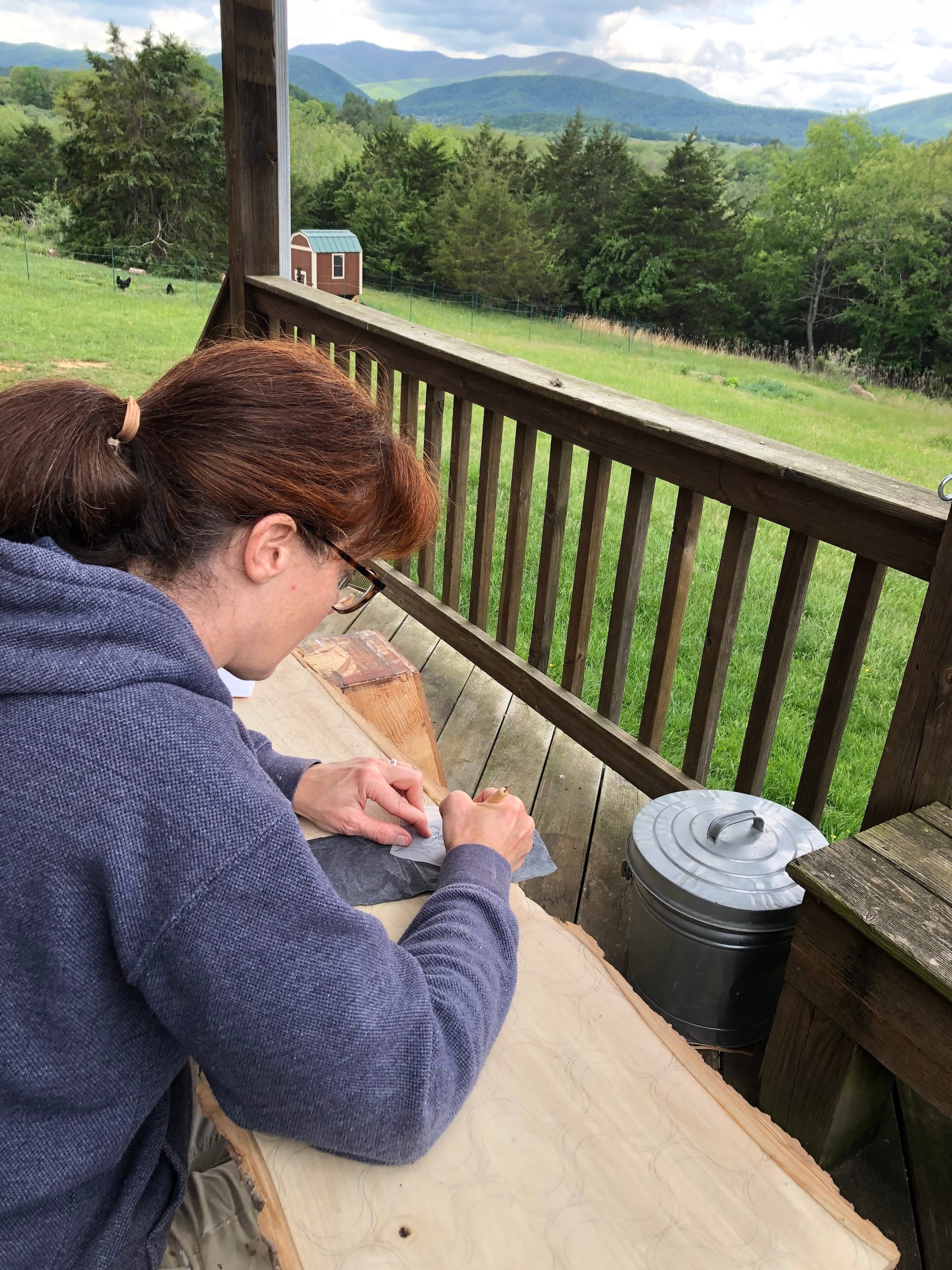
Heather McCoy stayed after class one afternoon in high school to talk with her art teacher about a project that she couldn’t get right. She had spent weeks on the design, and had worked it, in her words, to death. Oil pastel was the last medium she tried, and still she could not find the correct one for what she saw in her head.
She was close to tears.
Her teacher patted her arm and said, “Honey, there is no perfect answer in art.”
McCoy has carried that sentence for nearly forty years.
She remembers her reply too. She could not handle that, she said. There had to be a right answer somewhere.
She quit the class on the spot.
A scholarship, declined
The semester without an art class changed her mind. As college applications came due, Heather felt the pull again and began to wonder whether art might be her career after all. She took her portfolio to a college known for its art program, and a professor offered her a scholarship on the spot.
She panicked. Saying yes meant committing, and she could not see how she would survive as an artist, so she turned it down. She ended up in biology, and she spent the next thirty-plus years mostly away from art.
She never quit it entirely. Heather dipped back in from time to time and made a line of gouache greeting cards, figurines based on storybook characters, and a small collection of quilting illustrations. About three years ago she returned for good and started Trinity Point Designs.
A photograph on a dead Flickr account
Three mediums define her work now, and she reached each by a roundabout route.
Oil pastel was the medium of that last piece in high school. Gouache was what she used for the greeting cards, and she did not like the result. Pyrography, the craft of burning designs into wood, was the one she says she truly hated. The traditional method of line and shading never held her attention.
Then she found a photo on an old Flickr account that no longer exists. A college student had burned a table for an art thesis, and had done it differently. Rather than drawing with the burn, the student burned the background away and left the image standing in smooth relief. “The light came on for me,” McCoy says, and she had to try it.
She has been pushing at that technique ever since.
After a few years working only in monochrome, she wanted color. She went back to gouache and oil pastel. She now paints several color versions of each gouache design and loves it. “There is no right answer,” she says.
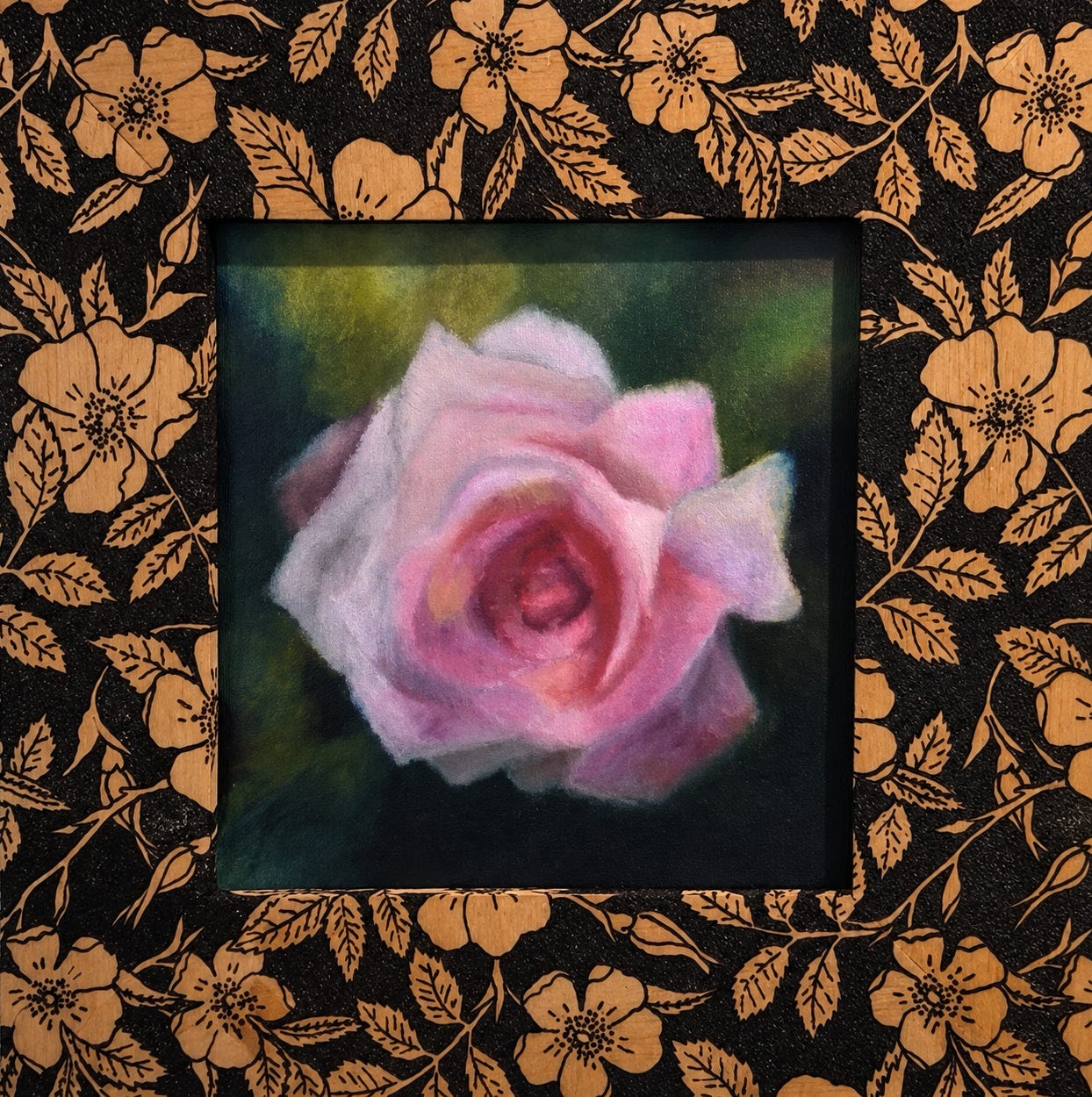
Oil pastel stays hard. She cannot work it in stages, because stopping breaks the flow, so each piece demands one long, draining sitting. About half of her attempts succeed. The failures get scraped off and thrown away. She pairs the successes with burned frames, which raises the stakes on every attempt, and those pieces have become her favorites.
Twenty hours before the first burn
McCoy does not design with pencil and paper. A composition lives in her head for months, shifting and settling, before she moves it onto an iPad in Procreate. She says the app, which cost her $13, was the best money she ever spent, and she calls its erase brush a game changer.
She cannot do thumbnails or rough sketches. She draws the design in near-finished form, the way she sees it, then erases, adds, cuts, pastes and nudges layers until it holds. A composition takes at least twenty hours, and some take twice that. The results look rough on the screen. All she needs is an arrangement she believes in.
From there, a free online program sizes the design, her home printer outputs it in sheets, and she tapes them together. She transfers the outline to wood or paper with graphite paper. She calls this the most boring part of the whole process.
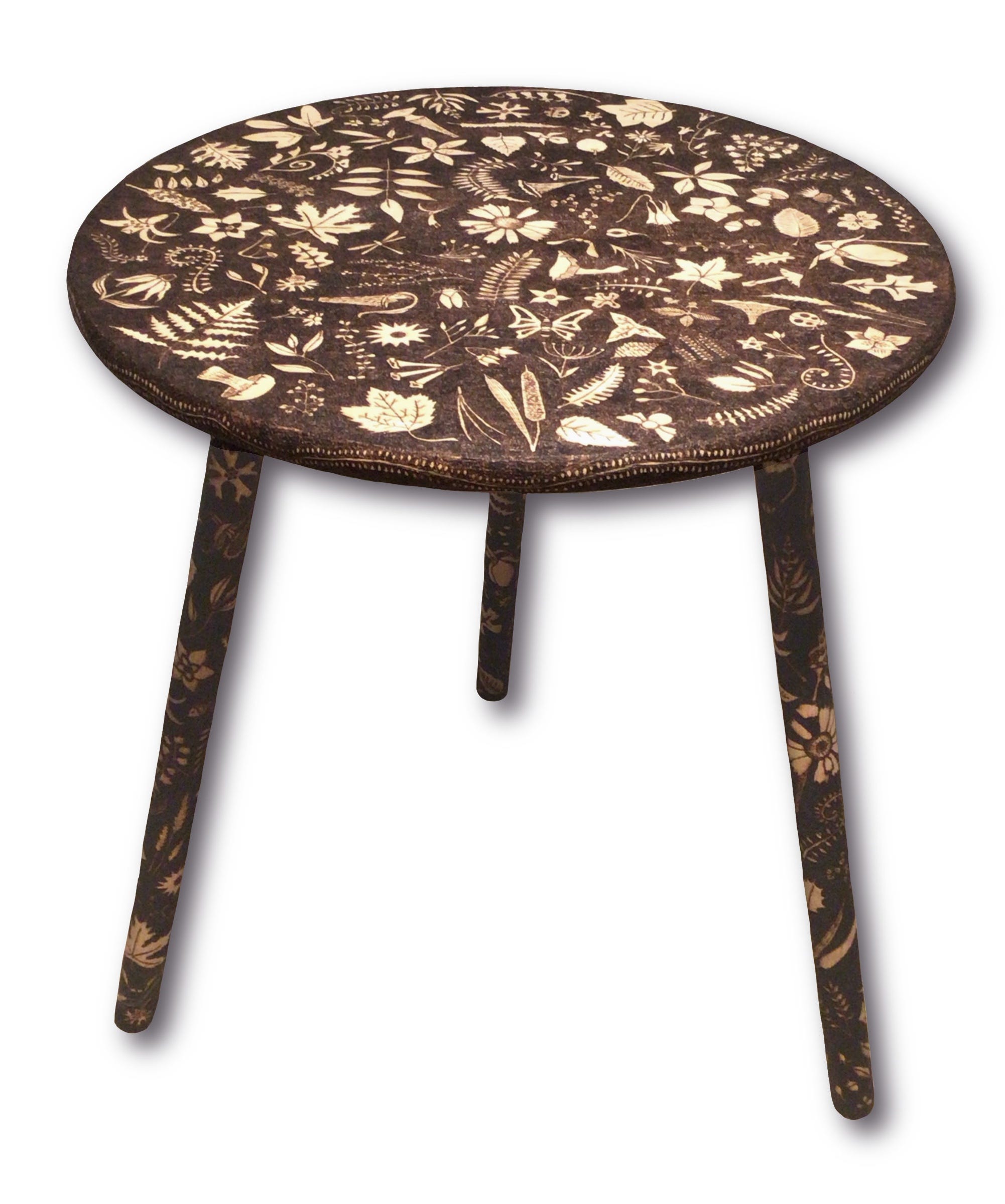
Then the burning begins, thousands upon thousands of small taps of the pen, one point at a time. She posts burn hours on her website because people seem more interested in those, though she calls the design phase the poor ignored stepchild nobody wants to talk about. A side table took 75 hours. A single Fire+Steel piece takes 20 to 25. Gouache moves faster once the design is done, and she can finish one in a few days.
Steel, cypress and a first table
Her newest addition is a set of steel frames for the Fire+Steel pieces, which she and her husband make from scratch. They cut, weld and grind the metal themselves. Heather finds the physical labor a balance to the stillness of burning. She says she is getting bit by the furniture bug again, and furniture is where she wanted to start. A table was the first thing she ever burned, if she leaves out a gourd birdhouse and a cheap craft-store pen she would rather forget.
Her bald cypress slabs were harvested in eastern Virginia. The soft maple and poplar for her tabletops come from a local lumber yard that she believes sources its wood in Virginia, though she says she is not certain.
Three peaks and a river
Trinity Point is a loose geographic patch of Augusta County in Swoope, where three peaks surround the meeting of the Middle River and Buffalo Branch. An old fort stood in the field next door. McCoy chose the name early in her return to art, when she thought she might add ceramics or fairy houses to the lineup and wanted a name roomy enough for all of it.
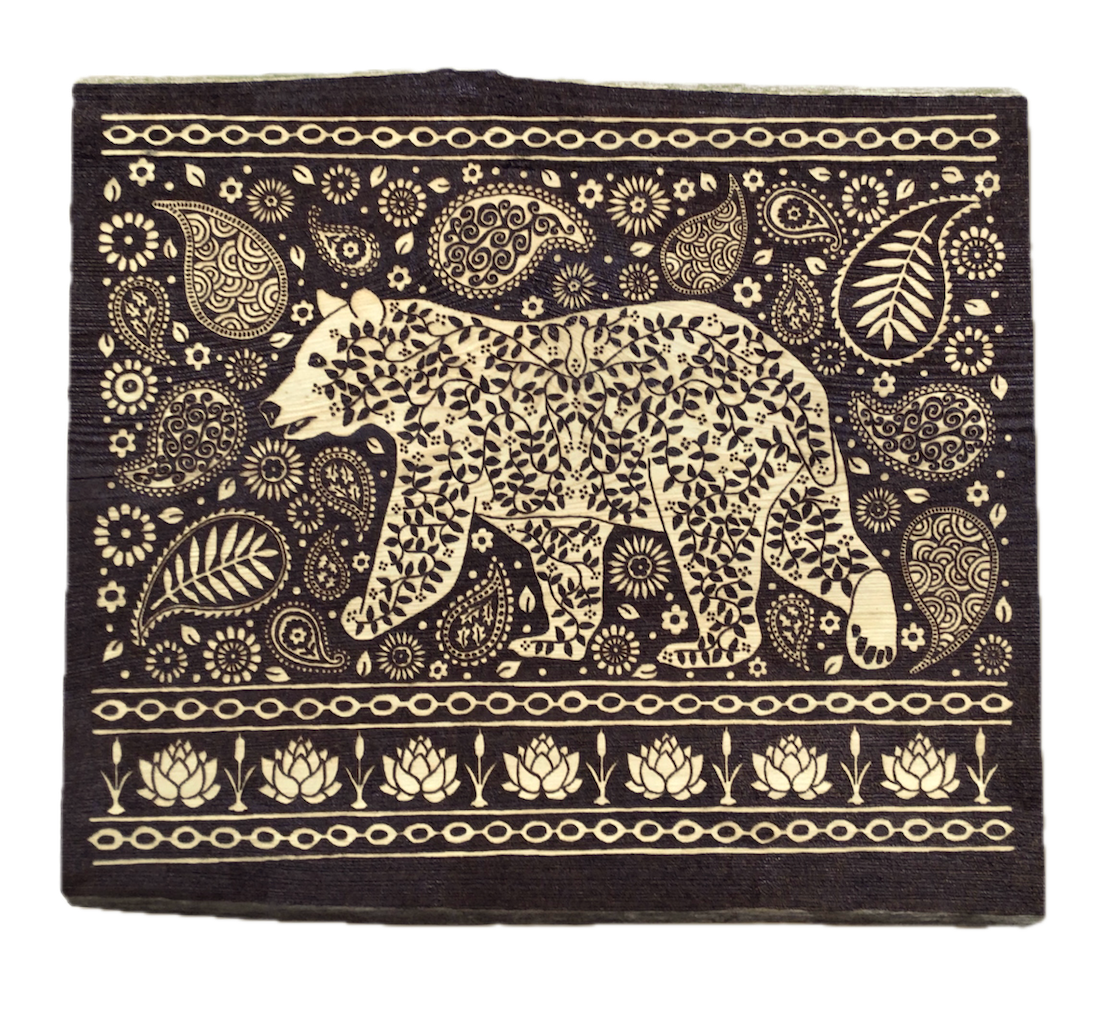
Heather’s Fire+Steel designs and gouache paintings lean on Arts and Crafts and Art Nouveau. The folklore, fantasy and Arthurian pieces show up in her burned slabs. Four Fantastic Beasts owes something to Harry Potter and Philip Pullman. Wisdom in the Water, her favorite woodburn, is a water dragon that took shape in her mind over six months. Coming of the Cosmic Firebird belongs to the same group. She loves these medieval, Tolkien-esque designs best, but they are not easy. They take a long time to develop.
The slow route to an audience
McCoy spent her first three years under the Trinity Point name building a body of work she liked. A year ago she began entering open art calls and winning some awards. A couple of months ago she decided to sell directly to buyers through her own website.
She tried the usual routes first: traditional galleries, social media, Etsy. None felt right to her or the work, which falls between fine art and illustration. A direct-to-customer site is slower, she says, but so are her mediums. She is content to be the tortoise.
Life as an artist in a rural county has its own difficulties, and McCoy calls herself a fringe artist. Her work falls between categories, her subject matter runs a little outside the mainstream, and woodburning is not widely known. Original pieces that take this many hours also cost enough that not everyone can take one home. By her own account she is a severe introvert, and mostly her closest neighbors know what she is doing. They have been encouraging. The internet, she says, is what lets rural artists find an audience beyond their own region.
Right now her work is available online only. She had a solo show in Richmond recently, and nothing local is in the pipeline. Anyone curious to see the pieces in person can ask about visiting her home studio, where they hang, and join her for a cup of tea.
Her teacher told her there was no perfect answer in art. Nearly forty years later, McCoy has stopped arguing.
Trinity Point Designs is based in the Trinity Point area of Swoope, in Augusta County. Work is sold online at TrinityPointDesigns.com.